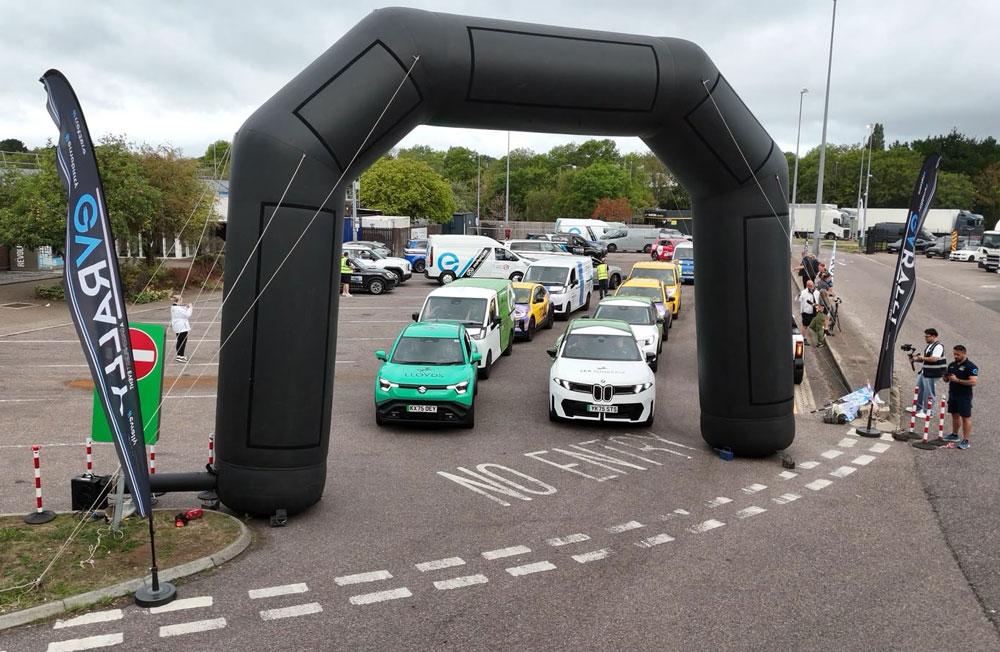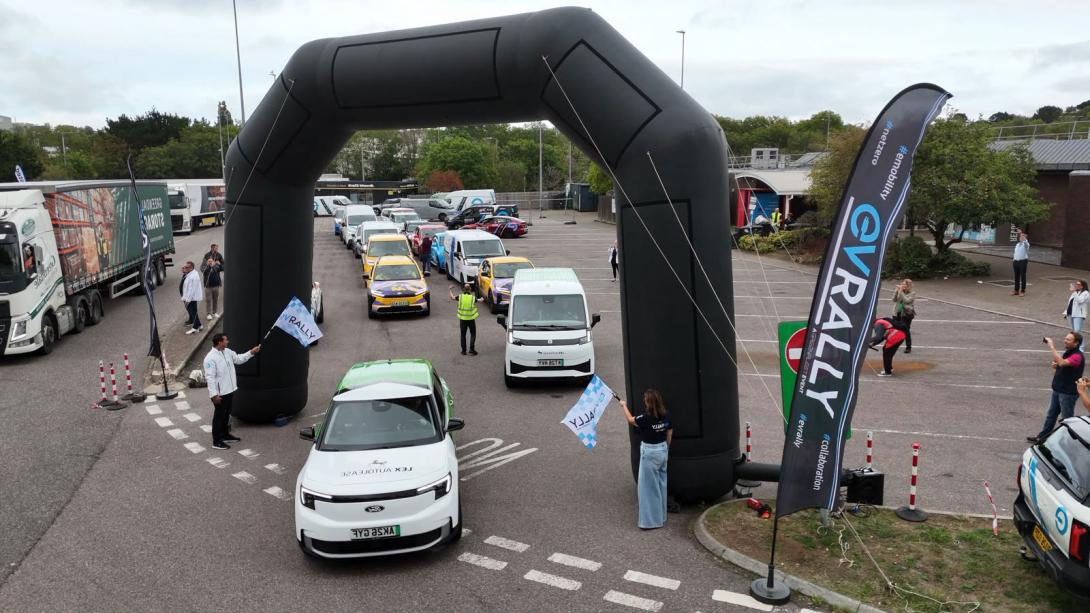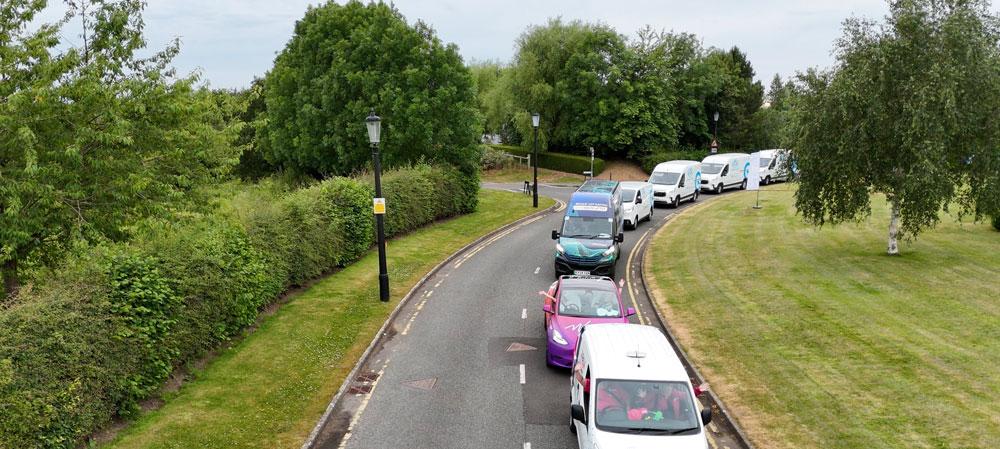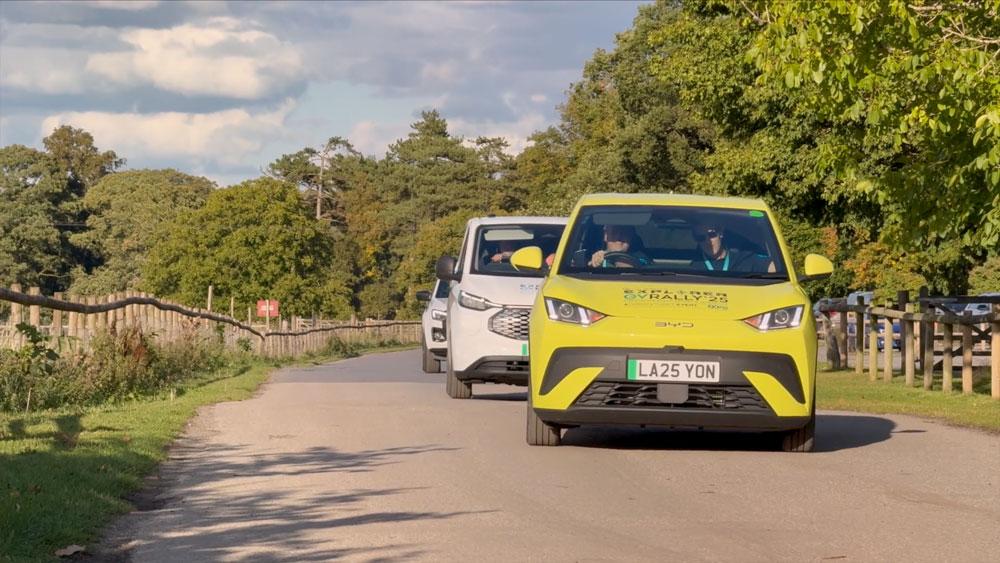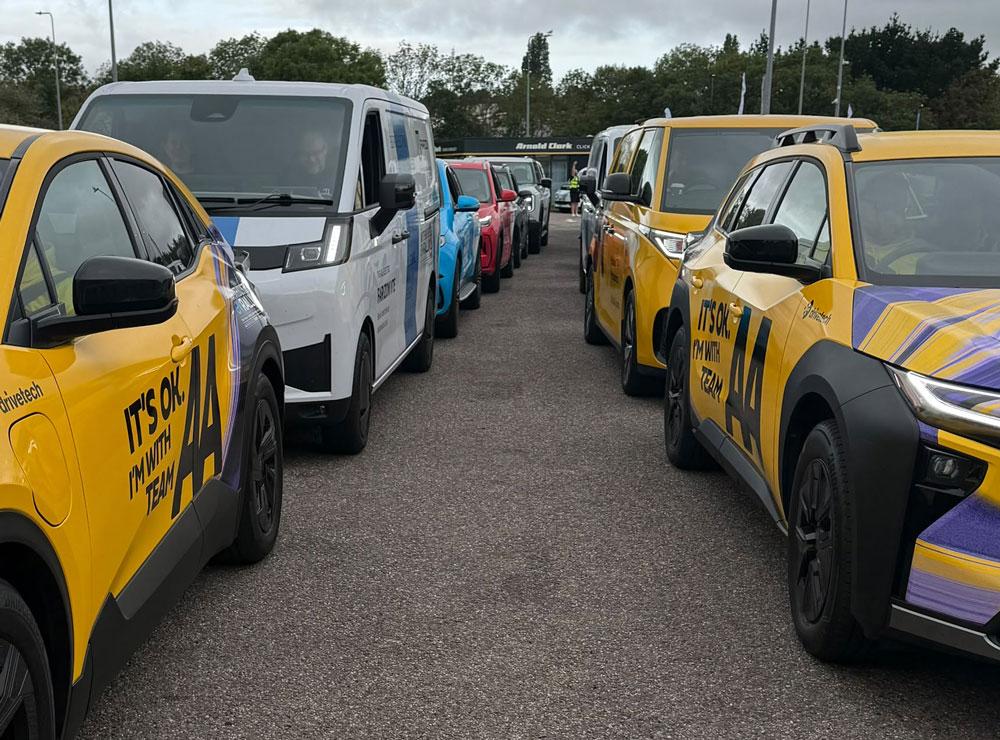
This year, the EV Rally set out to challenge the most persistent misconceptions around electric vehicles over its five days – and accomplished exactly that.
From EVs catching fire easily and batteries ending up in landfill, to electric vans not having enough payload, the Mythbusters EV Rally, sponsored by Lex Autolease, made it its mission to disprove false and outdated assumptions about electric vehicles.
Now in its sixth year, the EV Rally brings together teams from across the fleet, transport and energy sectors to demonstrate how electric vehicles perform over long distances and how the public charging infrastructure measures up.
For 2026, the Rally went further, with separate routes for cars and vans, and trucks and trailers, in recognition of their different operational and charging requirements.
Starting in Exeter on 7 September, the cars and vans travelled more than 1,000 miles through England and Wales, taking in rural roads, motorways and urban centres, before finishing at Allianz Stadium, Twickenham for the Everything Electric show on 11 September.
The Trucks & Trailers route covered around 900 miles, visiting dedicated electric truck charging hubs and demonstrating that the electrification of heavy transport is moving into real-world operation.
The result was a five-day practical demonstration of electric vehicle capability, infrastructure and innovation, with a number of myths and misinformation challenged on the way. Here are twenty of the myths the Rally busted.
Myth 1: EVs do not have the range or capability to do the job
One of the most cited arguments companies make against fleet electrification is that electric cars and vans simply do not have the range or capability required for real-world fleet operations.
The Rally put that argument to the test, with around 40 different electric cars and vans taking to the roads. Cars and vans completed daily journeys of between 200 and 300 miles, adhering to set stops and timelines. The results demonstrated that modern EVs can undertake substantial daily operations when routes and charging are planned appropriately.
The Rally also showcased the latest generation of EV technology, with two teams behind the wheel of the BMW iX3. With a quoted range of more than 550 miles on a single charge, these teams barely had to think about charging. In fact, one team stated they never needed to charge beyond 70% of the battery.
And while not every EV can travel 550 miles, the BMW iX3 does show how vehicle capability has evolved and what EV technology is capable of achieving.
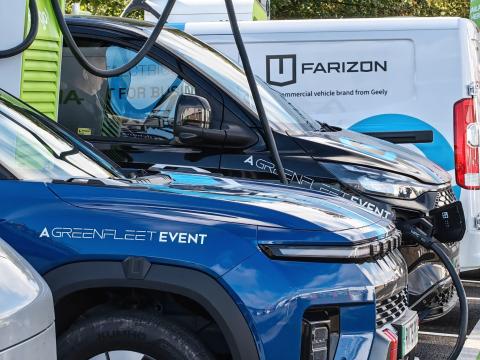
Myth 2: There is not enough decent public charging infrastructure
For many potential EV drivers, there is a fear that there will be nowhere to charge on route or at their destination.
The Rally provided a robust test of the UK's charging options, with stops at 100–400kW ultra-rapid charging hubs, 22kW destination chargers in local car parks – and everything in between.
With no team struggling to find a charge, the Rally showed how extensive the public charging network is, as well as the vital role that routing technology and apps play in seamlessly planning charging stops.
Myth 3: Public charging is prohibitively expensive
Charging costs vary according to location, charger type, operator and tariff, but the idea that public charging is universally unaffordable is not the case.
During the Rally, Arnold Clark Charge highlighted an ultra-rapid charging tariff of £0.55/kWh, reducing to 39p if subscribed to Octopus Electroverse, demonstrating that competitive public charging options are available.
Myth 4: EVs are constantly catching fire
Few EV myths have generated as much concern as the perception that electric vehicles are inherently dangerous because of battery fires.
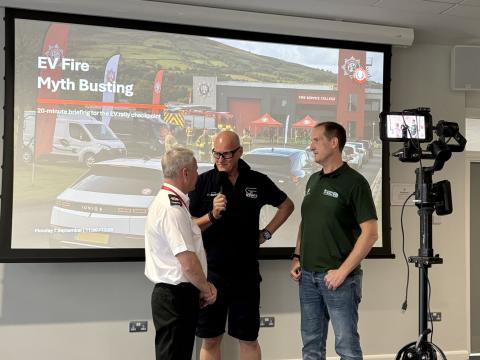
One enlightening check point on the Rally was the Fire Service College, where teams were able to explore what actually happens when an EV is involved in a fire. Lead instructor Paul Reames gave some data to give some perspective; EVs are 20 times less likely to catch fire than an ICE vehicle and on average, only five electric vehicles per 100,000, catch fire, compared to 110 ICE vehicles.
Myth 5: An EV fire is difficult to put out
Paul continued to highlight that EV fires are different from conventional vehicle fires, not more dangerous.
Battery fires present different challenges because of the possibility of thermal runaway and the potential for re-ignition. That means firefighters may need to manage the vehicle differently from a conventional car, including securing the area and monitoring the vehicle after the incident. Water remains the main firefighting resource - not any special foam or substance.
Myth 6: EV batteries don't last – and then they go to landfill
Concerns about battery degradation are often accompanied by the assumption that an EV battery will need replacing after only a few years.
The evidence emerging from modern EVs tells a different story. Analysis of over 22,700 electric vehicles by a leading telematics specialist showed that the average annual electric vehicle degradation rate is 2.3% and will often last beyond a typical vehicle’s service life.
The Rally's visit to Veolia's specialist EV recycling operation in Birmingham also showed what happens to vehicles batteries once they have reached the end of their useful life.
Teams got to see the recycling process at first hand. End-of-life batteries can be securely collected and discharged before being dismantled. Components are then separated mechanically, with battery cells processed to produce materials including plastics, metals and so-called black mass.
Veolia showed how valuable materials from the black mass can be separated and purified, allowing recovered metals to be used again.
Myth 7: There's no demand for second-hand EVs
There are some long-standing concerns over the second-hand EV market, with some people worry that an older EV will not have enough range and the battery won't last long. These are mostly outdated views and a stop at Arnold Clark's dealership in Wolverhampton gave teams the chance to find out about the reality of second-hand electric vehicles, as well as get a convenient charge on site.
Jamie Green, technical lead at Arnold Clark Charge, explained that the company has around 3,500 used EVs across its dealer network and that there is a massive choice of variety to suit most needs. And they are selling well - out of the 20 used vehicles on site the previous week, only seven remained.
Myth 8: EVs do not perform properly in hilly or rural areas
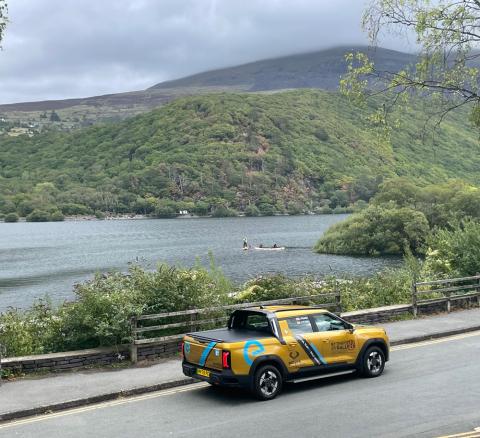
There are some concerns that electric vehicles cannot cope with steep hills or on rural roads. So, the Rally went looking for some of the toughest routes it could find.
Teams drove over the Llanberis Pass in Snowdonia and Harthope Moss in the Pennines, putting EVs through demanding climbs and descents.
And driving long stretches on rural roads also proved to be fine, with no vehicle running out of charge or unable to find a charger.
Myth 9: EV tyres end up in landfill
The assumption that used tyres simply have one destination – landfill – does not reflect the recycling processes already in operation.
During a checkpoint at Kwik Fit in Warrington, the company demonstrated how used tyres collected during replacement services can be processed and shredded into rubber granulate or crumb. Those recycled materials can then be incorporated into products such as sports surfaces, playground flooring and road applications.
Myth 10: Motorway service stations are not ready for EVs
The traditional motorway forecourt was designed around the internal combustion engine, leading to concerns that existing road infrastructure cannot accommodate large-scale EV adoption.
The Rally started at Moto Exeter, home to what was described as the UK's largest public charging hub, including dedicated electric HGV charging.
The experience showed how the conventional service station is evolving from a place to refuel into a place where vehicles can charge while drivers take a break.
Myth 11: Electric HGVs are not available in the UK
For cars and vans, electric models are now familiar. For heavy trucks, however, there is still a perception that the technology exists somewhere else and has yet to arrive in Britain.
Aiming to disprove this, one checkpoint on the Rally was the DAF factory in Leyland where teams could see electric trucks being manufactured in the UK.
With production capacity capable of building around 30 electric trucks per day, the visit provided a powerful demonstration that electric HGV manufacturing is already part of Britain's industrial landscape.
Myth 12: EV charging takes too long
Another barrier to EV adoption is the assumption that charging will take too long. The Rally demonstrated that with high-powered EV charging, this is not the case. At Gridserve Electric Forecourts and motorway service stations, teams were able to recharge rapidly, with many vehicles reaching 80 per cent charge before drivers had even finished their comfort break.
Indeed, one team driving the BMW iX3 was able to add 249 miles of range in just 15 minutes and a further 204 miles in 12 minutes, demonstrating that fleet downtime need not necessarily be a concern.
What the rally highlighted was that for most journeys, charging can be integrated into a driver's existing break rather than becoming a separate activity.
Myth 13: Electric vans are too heavy to carry useful payloads
It is often believed that an electric can cannot carry the payloads needed to do the job, with the weight of the battery often cited as a reason. The Rally challenged this perception.
Farizon, the Rally's Logistics Partner, supplied SV electric vans to the organiser’s crew, enabling them to carry equipment to each location ahead of the participants. With up to 13m³ of cargo volume and a payload capacity of up to 1,350kg, these vehicles showed that electric vans can work over long routes and in real world business operations.
What's more, the Rally visited System Edstrom in Corby, whose lightweight internal racking systems are designed to reduce the weight of van fit-outs.
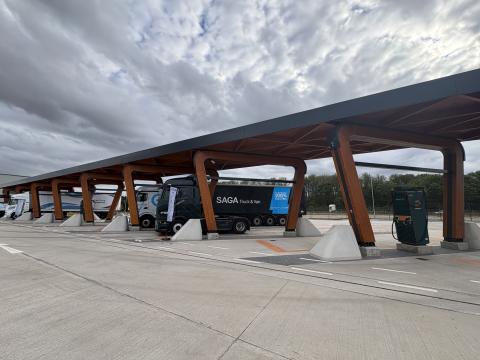
Myth 14: Electric HGVs have nowhere to charge
When the UK began its transition to electric vehicles, it was all about passenger cars. This means that much of the public charging infrastructure is not suited to larger vehicles, in terms of not having sufficient power, physical space or access.
The Rally's Trucks & Trailers route showed how things have changed.
Teams visited dedicated eHGV charging infrastructure, including Gridserve's Electric Freightway network and the Milence hub near Hull, where specialist high-power chargers and larger bays have been designed specifically around the requirements of electric trucks.
Myth 15: The UK has no joined-up approach to fleet charging
Many say that there is not a ‘joined-up’ approach to charging infrastructure in the UK, especially for fleets, but recent innovative thinking has addressed this.
The Rally visited Stagecoach's bus depots in Gillmoss, Chesterfield and Cambridge where its charging infrastructure is now being made available to other fleet users through Stagecoach's Chargd service.
Sharing depot charging allows companies to earn extra revenue when their charging facilities are not being used, and helps to accelerate EV adoption by plugging some of the gaps in existing public charging infrastructure provision, especially for HGVs and larger LCVs.
Myth 16: Mass EV adoption will overwhelm the grid
There is a long-standing question surrounding mass electrification and what happens to the electricity grid if millions of vehicles all plug in at once. But a number of emerging technologies is helping to address this.
Smart charging, Vehicle-to-Grid and Vehicle-to-X technologies mean that EVs can actually be part of the solution.
V2X technology allows vehicles to interact with homes, buildings and the electricity grid. EVs can be charged when electricity demand is lower and renewable generation is available, while compatible vehicles can potentially export electricity during periods of higher demand. That turns an EV from being purely an additional electricity load into a flexible energy resource.
The first checkpoint on the Rally was a EVjuiceNgo’s facility in Bristol, where the company demonstrated the V2X capability in its charging systems, showing how bidirectional energy flows could become part of the future charging landscape.
Myth 17: EV charging is disconnected from other forms of transport
Another misconception is that charging infrastructure exists in isolation, with little consideration given to how people actually travel.
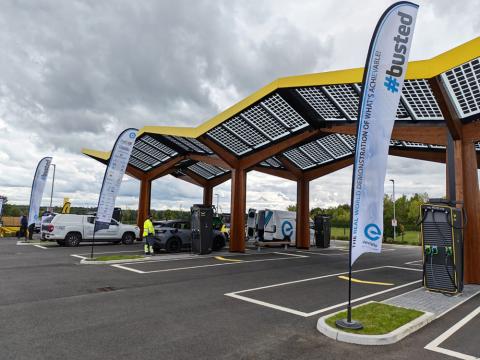
The Rally visited the Fastned hub at Newcastle Airport as an example of strategically located charging infrastructure close to another major transport hub. Airports, railway stations and park-and-ride facilities can all provide logical locations for EV charging, allowing charging to become part of an existing journey rather than an additional destination.
Myth 18: There is no EV charging innovation being developed in Britain
It is sometimes assumed that EV chargers are simply manufactured overseas and imported into the UK.
At EVjuiceNgo in Bristol, the Rally saw an established design and manufacturing business apply its expertise in industrial DC charging systems to the EV sector.
It was another reminder that electrification is not simply about importing vehicles and chargers. It is creating new opportunities for British engineering, manufacturing, software and energy businesses.
Myth 19: EVs have limited or no towing capabilities
There is a perception that EVs are no good at towing, unable to handle the additional load. KGM – the Rally’s Vehicle Partner – disproved this assumption. In an interview with John Curtis, KGM’s Clive Messenger spoke about how the Musso EV has a towing capacity of 2.3 tonnes which is enough for most trailers, horseboxes and caravans. Clive shared his own experience testing the vehicle with a trailer, noting its responsive handling, solid stability, and smooth overall drive.
Myth 20: EVs will never ‘take off’
Many still believe (and some hope) that EVs are just a fad and that they will never fully replace the ICE vehicle. The Rally finished at Everything Electric Greater London, at Twickenham, which is dedicated two-day event showcasing electric vehicles and clean energy.
Regularly attracting more than 20,000 visitors at each event, this reinforces that the interest in electric vehicles is real. And the massive number of electric vehicles on display shows the immense effort of the automotive industry to ensure there is an electric vehicle for everyone.
Beyond the myths
The final message from the Mythbusters EV Rally was not that every challenge with electric vehicles has disappeared. It was that the conversation needs to move beyond outdated assumptions to recognise how far electric vehicles and charging infrastructure has come.
And by putting a wide range of electric vehicles to the test across England and Wales, the 2026 Mythbusters EV Rally provided the real-world evidence to do just that.
For updates on next year’s Rally, contact Colin Boyton, Event manager at colin.boyton@psigroupltd.co.uk and visit www.ev-rally.co.uk