How do you decarbonise long-haul freight without disrupting the flow of goods? Dr Alex Foote explains a project that uses digital twins, AI-powered simulations and industry partnerships to help map out a future with electric HGVs
Here’s my route. I’m in London, and I need to get to East Midlands Airport in North West Leicestershire, where some of my cargo will be catching a flight.
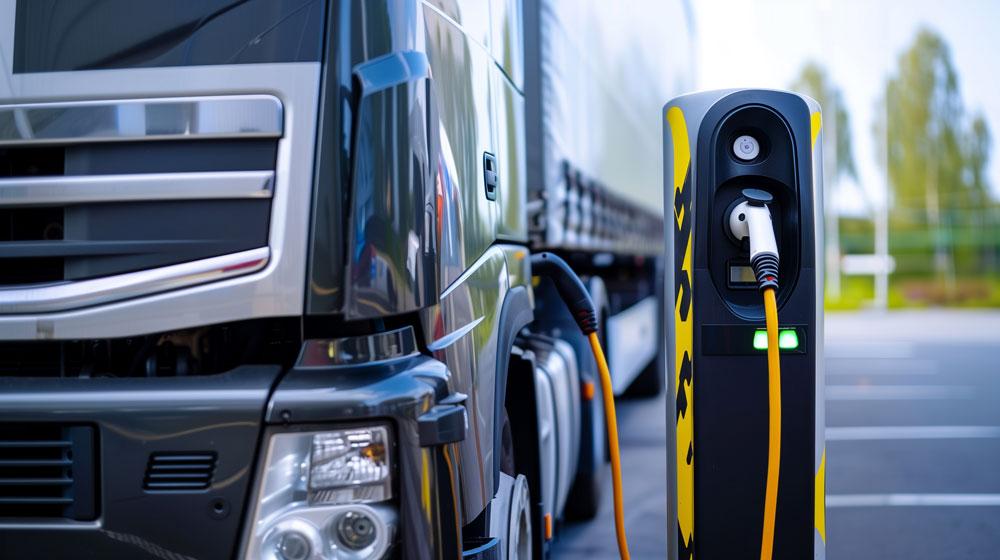
My truck is an electric heavy goods vehicle, so I’ll need to recharge the battery at some point. This means I need to know where and how long I can charge for.
The timings are tight. The cargo plane my goods are due on needs to leave on time, so any delays are a risk.
It’s a scenario that poses so many questions. Will there be a charging point available? Do any HGV charging points even exist on my route? How do I minimise the risk of delays? Would a single charge get me the whole way?
As a logistics and freight modeller for TransiT, these are the kinds of questions I explore every day. TransiT is a national UK research hub using digital twins – digital replicas of the physical world – to identify the fastest, least risky and lowest cost pathways to decarbonising transport.
We are fortunate to work with almost 70 industry partners across the UK’s transport, energy and technology sectors. And one of these, DHL, is providing critical support to my own research into decarbonising road freight.
DHL is an international logistics company employing around 400,000 people in more than 220 countries. The business aims to achieve net-zero emissions logistics by 2050 and in the UK, is providing TransiT with data from some of its UK fleet of around 6,500 trucks and vans.
We are using this to simulate journeys across the UK by a fleet of delivery trucks, with routes from London to East Midlands Airport electrified first, and other routes following in further simulations. We’re confident this is a UK first for research in this area, and the aim is to investigate what electric vehicle charging points are needed, and where, along the M1 motorway.
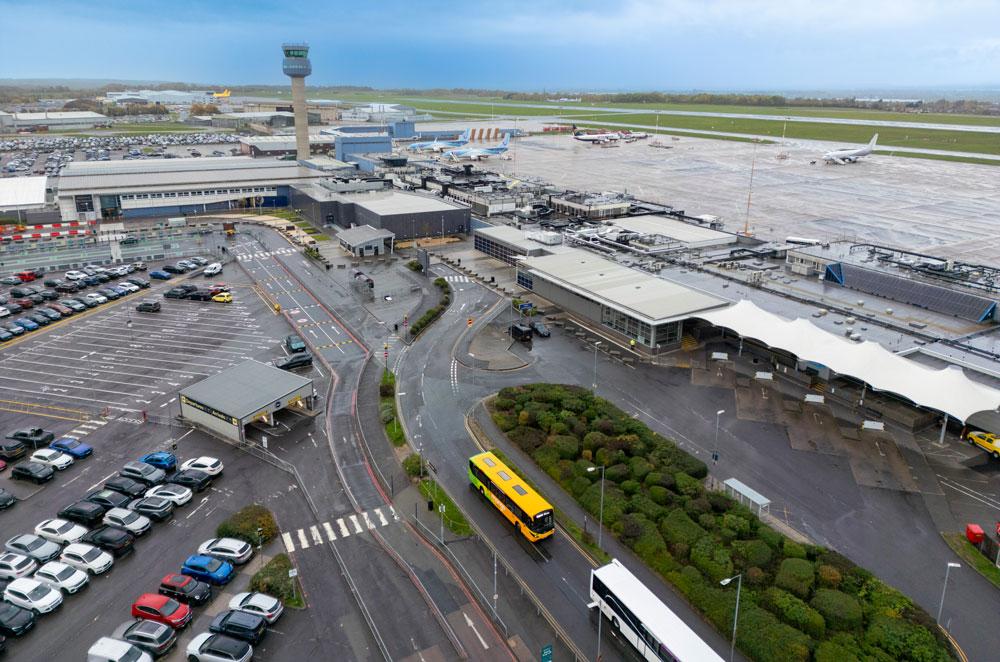
East Midlands Airport is our other critical partner in this research. The airport is the UK’s largest dedicated express air freight hub and handles around 400,000 tonnes of cargo a year. DHL operates cargo planes at the airport, carrying European and intercontinental air freight, so DHL trucks travel regularly between London and the East Midlands dispatching and collecting goods.
Simulation techniques
This gives us a rich seam of data for our other collaborators in this research – computer agents. Specifically, we use a computer simulation technique called agent-based modelling (‘ABM’) to visualise ‘what if’ scenarios – including future transport scenarios that don’t yet exist in the real world.
Agent-based modelling simulates how individual agents – like drivers and vehicles – interact with each other and their environment, and the impacts these interactions can have on the wider transport system. These models can identify the changes needed to ensure logistics companies remain reliable and profitable – including where vehicle charging points should be located, at what speed they should charge, and which mix of vehicles would be most effective for fleets.
The beauty of these computer agent truck drivers is that they can be in incentivised to find the most beneficial routes and locations. This is what I’ve been doing in my own research, and it involves giving our agents better scores if their trucks find shorter routes that reduce the time and cost of their journeys.
This might mean, for example, that our agents favour charging at their departure depot before starting their journey, during wait times between jobs, so they don’t have to stop en route. Or if it’s a long route, they might have to charge at a service station along the way.
The great advantage of agent-based models is that the agents can tell us what the best solution is.
A 2030 scenario
I’m currently simulating a 2030 decarbonisation scenario where 10 per cent of the fleet on DHL’s London to East Midlands Airport route is electrified.
This will identify locations, like service stations, where grid capacity may need to be strengthened to support new charging infrastructure.
Electric fleet adoption can then be increased in the simulation to 50 per cent by 2040 and 100 per cent by 2050, with the addition of new electric vehicles and infrastructure.
Ultimately, I’d like to try and find a way to demonstrate that electric HGVs in long haul freight are viable earlier than people expect – and that they can manage the journeys quickly and reliably.
We’re a bit behind the curve in the UK at the moment on electric HGV adoption, so it would be good to know that we can get the ball rolling quite quickly without too many big infrastructure changes.
Air freight simulation
Next steps for this research include integrating our road freight simulation with an air freight simulation being developed by our research partners at Cranfield University in Bedfordshire, in collaboration with DHL and East Midlands Airport. This will help our researchers understand the best decarbonisation pathway for air-to-road freight, as part of TransiT’s goal to build a connected network of digital twins representing the whole UK transport network.
As part of their research, Cranfield’s team are studying aircraft operations, as well as the energy and logistics systems that support them. This includes how aviation fuel is produced, transported and delivered. As the aviation sector shifts toward cleaner energy sources, our researchers are assessing what this means for emissions, costs and future infrastructure, and how the transition can happen in a practical and scalable way.
All of this work is part of TransiT’s Air and Road Freight Demonstrator project. This is one of three place-based ‘Challenge-Led Demonstrators’ involving interconnected road, rail, air and maritime systems across different regions of the UK.
Our demonstrators are designed to demonstrate and prove that digital twinning – and specifically a ‘whole system’ network of digital twins – can deliver scalable solutions to the integration and decarbonisation of transport.
Digital twins are digital replicas of real-world systems, processes or things – like vehicles, roads or traffic management systems.
They are created using data collected from the physical world in real time. This can include data from traffic cameras, sensors in vehicles, roads or tracks, and real-time positioning data from satellites.
The digital twin rapidly analyses the real-world data to test and improve different scenarios. It then sends back its solution for an improved process to the physical world. This exchange happens almost instantly – in close to real time.
In the transport sector, digital twins are increasingly being used to improve efficiency and sustainability through functions like predictive maintenance and route optimisation. But digital twin networks that can span and improve whole systems are still in the early stages of being developed.
This is where TransiT comes in, and we hope that digital twinning can deliver transformative change – where real world trials would be too costly, and would take too long.
By using technology to visualise what works and what doesn’t, our ultimate aim is to remove risk and uncertainty in the transport transition – so that fleet operators can move ahead – and the UK can deliver its net zero goals.
Dr Alex Foote is a research associate at Heriot-Watt University in Edinburgh working with UK research hub, TransiT.