Truck operators in Scotland are being invited to test a new planning tool designed to help accelerate the decarbonisation of road freight in Scotland.
The ScotVolt interactive dashboard has been developed for Transport Scotland, Scotland’s national transport agency, by researchers based at Heriot-Watt University in Edinburgh with The Centre for Sustainable Road Freight.
The tool explores what happens when Scotland's heavy goods vehicles (HGVs) switch from diesel to electric. Truck fleet owners and operators, hauliers, delivery companies and logistics firms are now being invited to test the tool against their own routes and submit feedback.
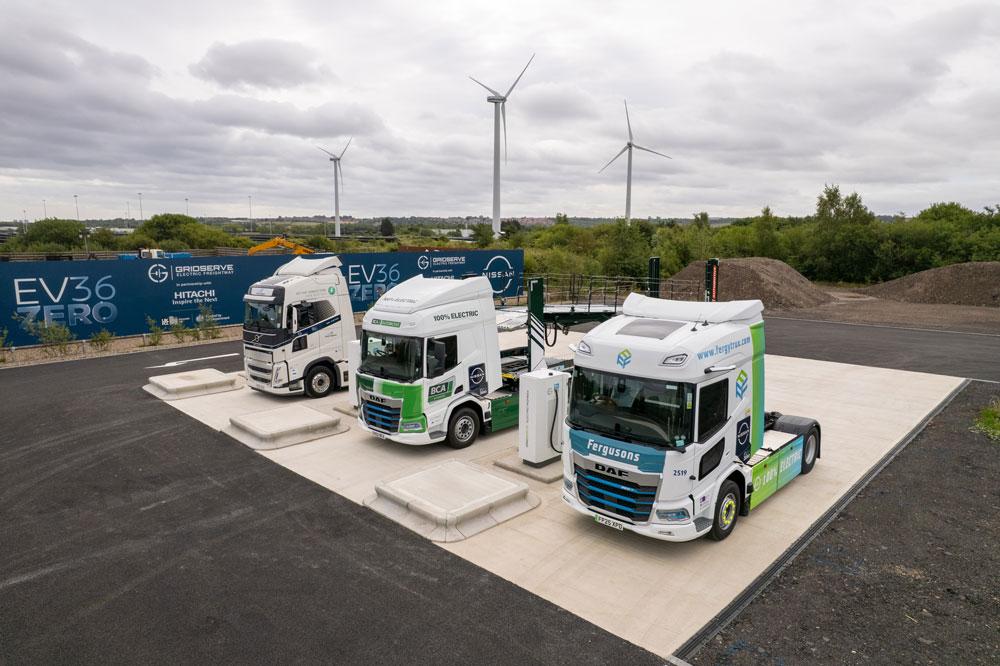
Using sophisticated computer modelling techniques and data from around 80,000 real truck journeys in Scotland, ScotVolt allows users to test different routing and charging scenarios to see where electric HGV chargers would be needed, how much electricity they would draw, and whether the local electricity grid can handle it.
The dashboard draws on two years of research commissioned by Transport Scotland and the Scottish Government through their HGV Decarbonisation Pathway for Scotland, published in March 2024 to help transition heavy goods vehicles to zero-emission technology.
Stephen Flynn, Cabinet Secretary for Economy, Tourism and Transport in the Scottish Government, said: “We pledged in our HGV Decarbonisation Pathway for Scotland to work collaboratively with industry to understand and overcome the barriers to zero emission HGVs in Scotland. The development of ScotVolt is a critical milestone in this work. It gives us a better understanding of what electric truck charging infrastructure is needed in Scotland – and helps operators explore their own transition to zero emission HGVs.”
Professor Phil Greening, a logistics expert at Heriot-Watt University and Deputy Director of The Centre for Sustainable Road Freight said: “One of the main barriers to decarbonising road freight is the inherent risk and uncertainty involved in such a large-scale transformation. It’s difficult for governments or businesses to invest in zero emission vehicles or technologies without a clear understanding of what this involves and what impact it could have. This is where computer modelling tools like ScotVolt can use real-world data to provide some answers – and derisk decision-making around freight decarbonisation.”
Covering six key freight corridors across Scotland – the A9, A90, A1, M74, A77 and A75 – ScotVolt runs simulations over a one-year timeframe across 56 different scenarios.
These reflect different variables including vehicle battery size, the availability and speed of charging stations and whether or not fleet depots can charge their trucks overnight.
The dashboard also captures seasonal swings in energy consumption between summer and the colder months of winter – when electric vehicle batteries tend to use more energy.
Dr Siti Fariya, a transport and logistics researcher at Heriot-Watt University, led the development of ScotVolt’s interactive dashboard and said: “Truck operators can test our tool by starting with a scenario their know. They can pick a season, route, depot type and battery size that matches one of their own routes and then load it. They can then flip any of the variables to see the impact. For example, what happens if they switch from 500 to 1000 kWh vehicle battery? Or if they instal electric charging bays in their depot? Ultimately our aim is to help fleet owners and operators make decisions about their own transition to electric trucks.”