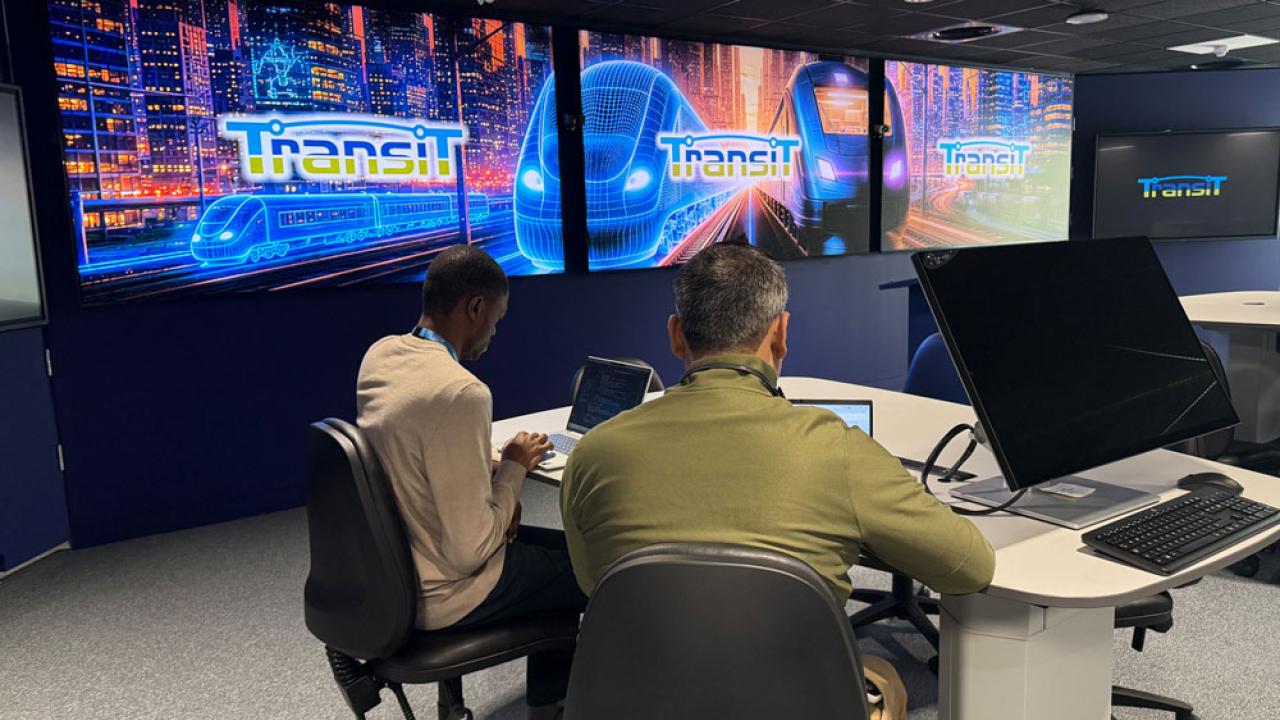
Funding of £1.2 million to support transport decarbonisation research is being offered by UK research hub, TransiT.
The funding is expected to support six UK-based research projects with up to £200,000 each, and will be awarded for one-year projects starting in April 2027.
TransiT’s new ‘Flexible Fund’ is supported by the UKRI Engineering and Physical Sciences Research Council (EPSRC), the main funding body for engineering and physical sciences research in the UK, and is open to UK universities or other research institutions.
TransiT is a collaboration of eight universities and more than 70 industry partners that is using digital twins – digital replicas of the physical world – to identify the fastest, lowest-cost and least-risky routes to transport decarbonisation in the UK, across road, rail, air and maritime.
Professor Phil Greening, TransiT Programme Lead at Heriot-Watt University in Edinburgh, said: "TransiT was launched with the vision of de-risking transport decarbonisation by using state-of-the-art digital twinning and prediction tools. We’re now at a critical juncture in our research – and this funding will unlock new areas of that work – as well as supporting other researchers in this field.”
Professor David Flynn, TransiT Joint Programme Lead at University of Glasgow, said: “Our early advances at TransiT have laid the foundations of a digital twinning framework for critical national infrastructure in the UK. We now welcome new experts and stakeholders to take part in this exciting research mission.”
Research proposals must align with one or more of TransiT’s ‘Challenge-Led Demonstrators’. These use real-world settings and data, in collaboration with industry partners, to show that digital twinning – and specifically a ‘federated’ (interconnected) network of digital twins – can deliver scalable solutions to the integration and decarbonisation of transport.
TransiT’s Demonstrators include its Maritime and Road Freight Demonstrator at the Port of Dover, its Passenger Transport Demonstrator in the West Midlands and its Air and Road Freight Demonstrator at East Midlands Airport. TransiT also has a Vehicle Digital Twin Demonstrator, which is creating a digital twin of a heavy goods vehicle. TransiT’s aim is to bring these digital twins together as an interconnected network in its Federated Digital Twin Demonstrator. This system of independent, but linked, digital twins will be used to test decarbonisation solutions that could be applied across the whole UK transport system.
TransiT invites research submissions that can establish a rigorous methodology for understanding federated transport systems, with a particular focus on data, semantics, interoperability, performance and assurance.
Funding proposals should also address one or more of TransiT’s thematic priorities.
Applicants to TransiT’s Flexible Fund must submit an expression of interest by 19 October 2026, with selected applicants then invited to develop a full proposal. Projects will start in April 2027 and must be completed within 12 months. All projects must secure at least 30% matched funding from industry partners, either as direct financial contributions or as in-kind support.
TransiT is jointly led by Heriot-Watt University and the University of Glasgow, and supported by EPSRC and by the UK government’s Department for Transport.
TransiT’s other university partners are University of Leeds, University of Birmingham, Cranfield University, University College London, University of Cambridge and Durham University.