According to the BVRLA’s latest annual Road to Zero Report Card, the UK's transition to zero emission road transport is uneven, with some parts of the market moving in the right direction and others lagging behind.
The report, which explores decarbonisation progress across vehicle supply, demand and infrastructure, gives annual scores for cars, vans and trucks.
Toby Poston, BVRLA Chief Executive, said: “The UK does not have one EV transition. It has multiple transitions moving at different speeds. Cars are ahead of vans. Fleet is ahead of private retail. New vehicles are ahead of used. Home charging is ahead of public charging. Large corporates are ahead of SMEs. Leasing is ahead of rental. Urban use cases are ahead of rural and heavy payload operations.
“This disparity in progress is a warning light that the EV ecosystem has challenges outside of the comfort zone of company provided cars and home charging.
“The transition gives us many reasons to be cheerful, but we need to see focus shift to the areas that desperately need it.”
The 2026 update highlights that, despite improving cost differences between electric cars and petrol, the impacts of continued pressure in the van market and persistent concerns around charging infrastructure are holding the transition back.
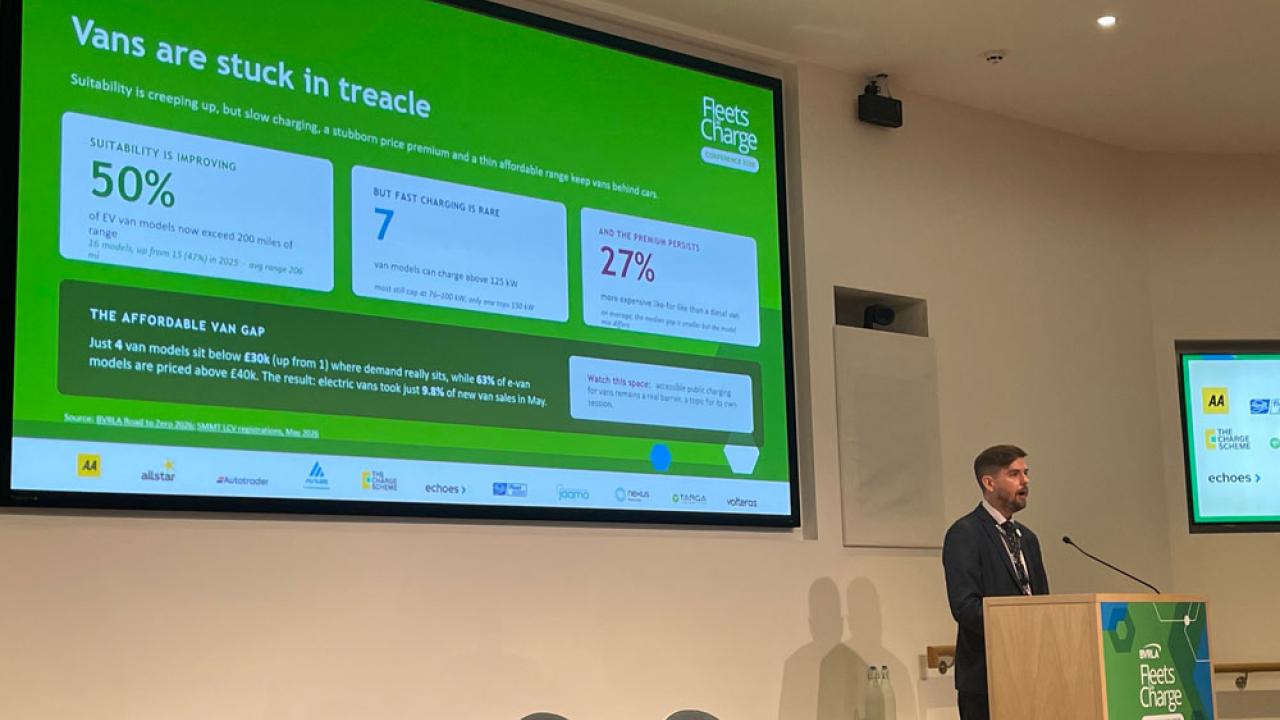
The sharpest challenge is in vans, where the transition is struggling to build momentum. Operators face a limited choice of suitable vehicles, a significant cost gap compared with diesel, and a charging network that is often at odds with how vans are used in the real world. For too many fleets, the operational case for switching remains difficult to make.
Elsewhere, the Road to Zero Report shows that the economic picture for electric vehicles is improving in some areas. The gap between EV and ICE refuelling/recharging costs is narrowing, with the balance between petrol prices and public charging costs moving in favour of electric, due in part to fuel costs rising in response to the conflict in the Middle East.
Further positive signals can be seen in vehicle repair and availability. Electric vehicles are proving cheaper and quicker to repair, challenging some of the assumptions around whole-life costs and operational risk. Availability of more affordable models is also improving, with more than twice as many new electric cars priced under £30k compared to last year’s report.
Offsetting that positive movement is the availability and reliability of the public charging network. Deployment of infrastructure is growing, but not at the rate to support the pace of transition, while the reliability of chargepoints already in the ground remains inconsistent.
Across all vehicle types, the Report highlights the need for a more balanced transition. The BVRLA is calling for continued collaboration between government and industry to ensure recent policy interventions deliver measurable impact. Among its asks are targeted support for the van market, faster delivery of reliable charging infrastructure suited to real-world use cases, and a policy framework that gives fleets the confidence to invest.