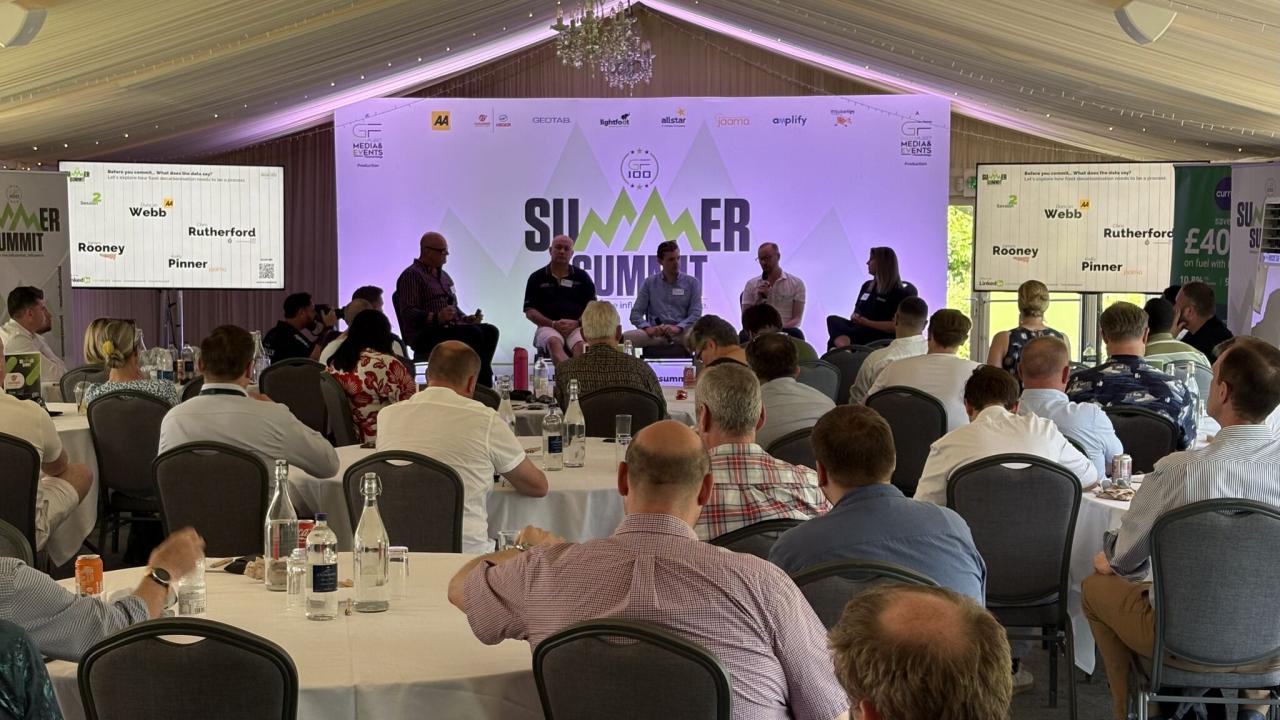
Industry leaders from across the fleet and transport sectors have called for greater government certainty and policy consistency to support the UK's transition to zero-emission transport, following discussions at GREENFLEET's inaugural GF100 Summer Summit LIVE!, held on 24 June at Hunton Park Hotel in Watford.
The event brought together many of the individuals recognised in the GF100 Most Influential list, which celebrates those driving meaningful progress in fleet and transport decarbonisation.
Hosted by sustainability expert John Curtis, the Summit created an unusually candid environment where fleet operators, manufacturers, infrastructure providers, and other key stakeholders were able to debate both the successes and frustrations of the UK's transition to zero-emission transport.
Audience participation through live polling and Q&A ensured the conversations reflected the real-world challenges facing fleets, with a clear message emerging: fleet decarbonisation is difficult and while the fleet industry remains committed to decarbonisation, achieving it will require clear, stable and long-term government policy.
Indeed, 37 per cent of attendees cited uncertain government policy as the leading concern for fleet decarbonisation, with charging infrastructure following closely at 35 per cent. Cost and budget constraints accounted for 14 per cent of responses, vehicle suitability and availability received nine per cent of the votes, while only four per cent identified internal organisational resistance as the primary challenge.
Robert Evans, CEO of Cenex, highlighted concerns surrounding ongoing discussions around potential changes to the Zero Emission Vehicle (ZEV) Mandate, warning that uncertainty could discourage investment and slow progress.
"The government sees the zero-emission targets as years away, but for a fleet that's only one or two replacement cycles," said Evans. "With the cost of transitioning so significant, businesses need confidence that the policy isn't going to change."
Lamech Solomon, Head of Decarbonisation at Logistics UK, emphasised that enthusiasm for decarbonisation remains strong among commercial vehicle operators, but infrastructure development must keep pace with policy ambitions.
Catherine Bowen, Head of Decarbonisation & Future Mobility at the BVRLA, focused on the challenges facing electric van adoption. While acknowledging progress made through industry engagement with government, she said barriers remain around charging infrastructure, vehicle practicality and the realities faced by SMEs. Many van drivers, she explained, take vehicles home rather than returning to a depot, increasing reliance on public charging infrastructure when home charging is not available.
Panelists Chris Rutherford, Next Generation Ambulance Programme Lead at London Ambulance Service NHS Trust, Duncan Webb, Head of Fleet at The AA, James Rooney, Head of Road Fleet at Network Rail, and Kelly Pinner, Head of Business Development at Jaama, spoke of the importance of data in the zero emission transition.
Meanwhile Sam Clarke, Head of eHGV at Gridserve, Stuart Murphy, Head of Fleet Transformation & Integration at Royal Mail, James Hooker, National Bus Sales Manager at Harris Bus and Coach, and Thomas Rowlands, Managing Director, Global EV Solutions at Allstar (Corpay) discussed the progress and challenges of commercial vehicle electrification.
The speaker sessions concluded with the top three individuals from the 2025 GF100 Most Influential list: Paul Hollick, Chair of the Association of Fleet Professionals and CEO of Lightfoot; Lorna McAtear, Head of Fleet at National Grid; and Sara Sloman, Global Partnerships Director at Paythru. Their discussion once again returned to the importance of policy consistency, with panellists warning that uncertainty risks slowing investment and leaving the UK behind other nations in the race to decarbonise transport.
Angela Pisanu, GREENFLEET's editor commented: "The discussions at the inaugural GF100 Summer Summit demonstrated both the ambition and the realism that exists across the fleet sector.
“Organisations remain committed to decarbonisation, but they need confidence that government policy will provide a stable framework for long-term investment. Bringing together so many influential voices in one room showed exactly why collaboration will be critical in delivering the UK's net-zero ambitions."
The Summit also provided the backdrop of GREENFLEET's inaugural GF100 Rising Star Awards, sponsored by The AA. These awards recognise emerging leaders making a positive impact within their organisations and across the wider fleet sector. The 2025 winners were Rosario Surace of Drax Electric Vehicles, Lois Loxley of Zemo Partnership and Harry Chapman of Speedy Hire.
Delegates were also able to get expert advice from sponsors The AA, Geotab, Amplify, Lightfoot, EVjuiceNgo, Jaama, Harris Higer, and Allstar - a Corpay Company.
The day concluded with a networking BBQ on the hotel lawn, providing attendees with an opportunity to continue discussions, strengthen industry relationships and celebrate the collective efforts being made towards a zero emission fleet and transport industry.