InstaVolt has announced the opening of five new battery energy storage system (BESS) sites as part of its programme to future-proof its charging hubs against rising grid costs and connection delays.
The five sites, each representing an investment of approximately £500,000, bring the total number of battery-equipped InstaVolt locations to eight, and at least 20 further sites are planned before the end of 2026.
The programme addresses two structural pressures that are intensifying across the public charging sector: escalating network demand charges, which increase in line with peak power draw, and grid connection delays that are holding back deployment of the rapid charging infrastructure the UK needs.
Delvin Lane, CEO, InstaVolt, said: “Battery storage is one of the most powerful tools we have for accelerating the switch to electric. It lets us deploy faster, manage our costs more effectively, and pass genuine savings on to drivers. Our batteries charge overnight when energy is cheaper and cleaner, and we draw on that stored power during the more expensive daytime hours. That saving goes to the consumer. When you factor in standing charges, VAT, and the full weight of infrastructure costs, passing savings on to drivers is not the easy option. It is the right one, and it is what we are committed to doing.”
Dr Andy Palmer, CEO / Founder, Palmer Energy Technologies, said: "The grid connection problem is real and it isn't going away quickly. What InstaVolt has understood is that you don't have to wait for it to be solved centrally before you invest. Store cheap overnight power in batteries, draw it down during peak hours, pass the saving to the driver. That's not complicated, it's just disciplined infrastructure thinking. The Corley data tells you everything you need to know: a 33% increase in energy delivered per session because drivers can actually charge at the speed the hardware is capable of. That's what good engineering looks like in practice."
By integrating on-site battery storage, InstaVolt sites can draw power from stored reserves during peak charging periods, reducing exposure to demand tariffs and meaningfully increasing the total power available to drivers at any given moment. Sites can also open on smaller initial grid connections, with battery capacity compensating for the gap, cutting deployment timelines significantly. These sites, where grid connections would otherwise limit performance – particularly on motorways and in rural locations where grid capacity is notoriously constrained – allow InstaVolt to supplement grid supply, allowing chargers to operate at higher speeds, directly improving the experience for drivers.
The impact is already showing to be measurable. At both InstaVolt’s Corley service sites, the addition of 230 kVA of battery capacity brought the sites’ total available power to 500 kVA (each) across seven and eight chargers respectively. Since the upgrade, energy delivered per session has increased by 33% at Corley South and 22% at Corley North, reflecting how drivers charge more completely when higher power is available.
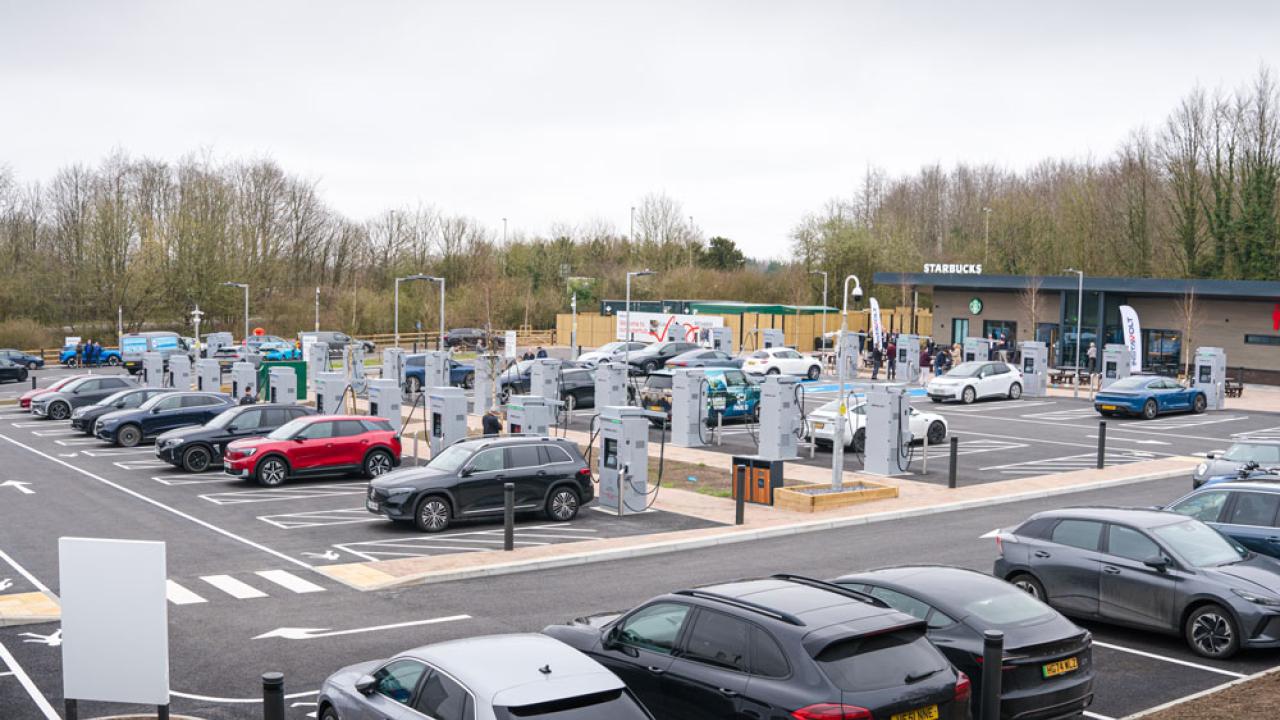
Moreover, the flagship site, the Winchester Superhub, is already proving to be an energy model for the future, demonstrating what smarter public charging can look like. Batteries are charged at off-peak grid rates and supplemented by on-site solar, allowing InstaVolt to offer drivers consistently lower prices regardless of when they charge. In March alone, 42,000 kWh of solar generation contributed zero-cost power to the network. 91% of all energy sold was delivered during peak hours between 7am and 8pm, even though 89% of energy purchased from the grid was during off-peak hours and stored in the batteries. Drivers benefit from that economic shift without needing to think about when they plug in.
This summer, the model is enabling a reduced rate of 70p per kWh, supported by increased solar generation. As battery and solar capacity grow across the network, Winchester represents the template for how InstaVolt intends to operate.