Cross River Partnership works with London’s boroughs and businesses to deliver cleaner, more efficient freight. Project manager Sefinat Otaru shares insights shaped by the partnership’s work and on-street trials
Freight and servicing keep London’s economy moving, yet their footprint on air quality, street space and reliability still outweighs the benefits. For decades, Cross River Partnership (CRP) has worked with boroughs, BIDs, operators and landowners to treat logistics as infrastructure: planned for, tested in real conditions, and continuously improved. That shift away from ad hoc fixes toward whole-system delivery is now visible across London, where governance, monitoring and operations are beginning to align in a way that makes progress stick.
Why the shift starts
Freight pilots and vehicle swaps were common in earlier years, but recent coordination has brought freight into mainstream transport and place strategies. Camden’s 2024 Freight and Servicing Action Plan shows this shift by applying Reduce, Remode and Retime measures through procurement, servicing windows and consolidation. This aligns with TfL guidance and Local Implementation Plan rules, which give boroughs a clear route to operation and require monitoring. Where planning processes have been updated, micro hub fit-outs, traffic orders and bookable loading bays move more quickly. Where they have not, decisions take longer while policies catch up. As the foundations of planning and policy strengthen, the next step is to understand how these ideas perform in real-world conditions.
Where the idea is tested
The Pimlico Micro Logistics Hub shows how underused space becomes everyday infrastructure. CRP and Westminster City Council converted bays in Q Park Pimlico, so parcels arrived by electric van and left by e-cargo bike. Monthly insights during the 2023 trial and a nine‑month evaluation quantified zero‑emission kilometres and emissions savings compared with van deliveries; across the trial period, e‑cargo bikes travelled 22,578 km and avoided an estimated 4,186 kg of CO2.
After the funded phase, operators agreed to continue independently, a strong sign that the service was reliable and valued. Westminster Lord Mayor Paul Dimoldenberg captured the rationale, saying the hub “has an important part to play in promoting healthy, greener and more efficient deliveries” across the city. Once a concept proves itself in one location, the next question is whether it can work at scale.
Where the idea scales
At Team London Bridge, more than 200 businesses have shifted their courier, servicing, and waste contracts to zero-emission providers through Bikes for Business and practical guidance. The portfolio approach matters: when multiple occupiers adopt clean services at once, improvements are quick, and replication becomes achievable in areas with similar density.
Cleaner deliveries and more reliable journey times strengthen the case for rolling out cargo bikes across central London. The BID’s role, making options clear, lowering barriers for SMEs and coordinating interest, shows just how much local leadership can accelerate change. With more businesses adopting cleaner services, attention turns to the public realm and the practicalities of making street operations reliable.
How the street works
Kerbside reliability sets the tone for everything else. CRP’s Dynamic Kerbside trials used bookable loading in constrained locations, including pedestrianised streets and brewery logistics, where proximity and timing are critical. Predictable slots reduced dwell and circulating traffic; across the network, 30 operators made over 650 bookings at eight Virtual Loading Bays, showing strong early adoption and demand for guaranteed kerbspace.
Tradeteam Salford’s Jonathan Penfold described Virtual Loading Bays as “a game changer for the safety of our staff delivering into pubs” because parking closer to delivery points cuts manual handling risks. Trials across multiple boroughs proved that clear hours, visible rules and proper operator onboarding determine compliance more than the tech itself, a practical point often raised by officers and operators alike.
When the river joins in
With hubs and kerbside improving reliability on the street, the middle mile is shifting, too. River logistics are back in serious discussion. Although the Thames Estuary Growth Board has since closed, the memorandum of understanding it signed with the Port of London Authority and Thames Freeport continues to shape the Riverside Urban Logistics Environment (RULE) project which is now progressing under Connected Places Catapult and other delivery partners. The ambition remains the same: shift meaningful parcel volumes off the road and onto the Thames, completing the last mile by low or zero-emission vehicles. A phased pilot approach is designed to build commercial confidence while reducing road impacts along the corridor. As interest in river-based and multimodal models grows, the next question is how this momentum extends to major rail locations.
Where the step change happens
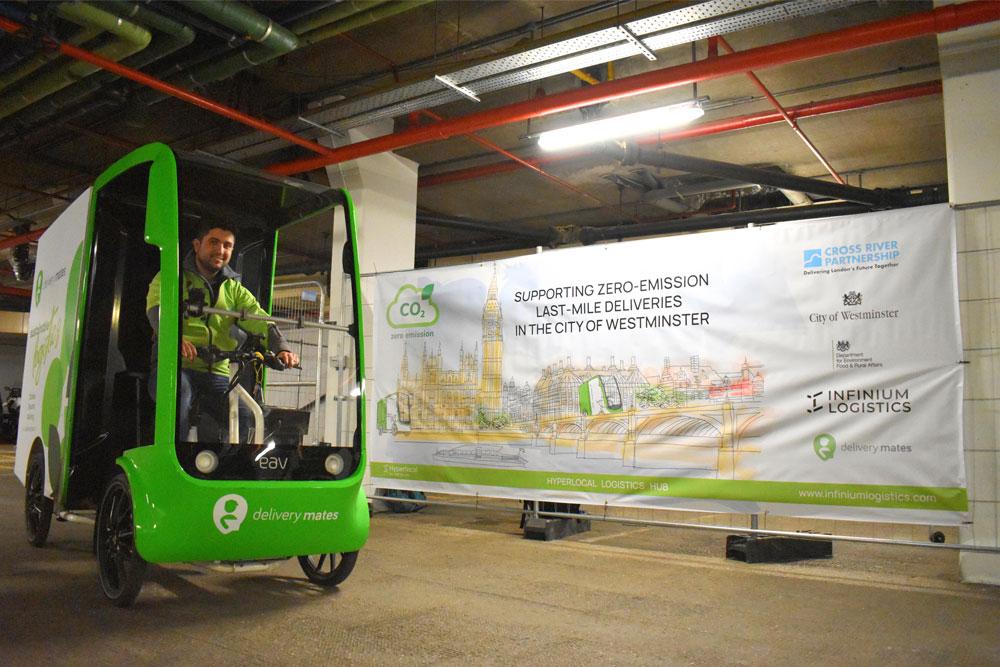
The Waterloo Freight Hub brought the logistics reset into the rail estate at London’s busiest station. Working with Network Rail, Lambeth, DfT, LCR and Delivery Mates, CRP converted an undercroft arch into a six-month, road-fed trial, with outbound cargo bikes covering almost 5,000 kilometres, delivering more than 20,000 parcels and saving around 2.5 tonnes of carbon compared with van-based last mile deliveries.
Network Rail’s acting chair Mike Putnam said the hub can “demonstrate the potential to trial zero tailpipe emission infrastructure and future rail freight opportunities” at a major station. The trial’s strong results and the recent CiTTi Last Mile Logistics Award now make it possible to move forward with a larger hub that accepts middle-mile deliveries from road, rail or river. As larger schemes bed in, technology becomes relevant only where it supports these real-world operations.
What tech supports the plan
Technology earns its place when it helps solve real problems. In healthcare logistics, Guy’s and St Thomas’ with Apian and Wing have moved urgent clinical samples by drone between hospital sites, cutting travel times and extending approvals as operations mature. On the road, public attention is on passenger autonomy, with Wayve and Uber preparing trials tests of cars that can drive themselves without human intervention in set conditions. For freight, though, the gains available at scale today remain in cargo bikes, micro hubs and bookable loading – tools that already work and already integrate cleanly with London’s constraints. To sustain these benefits, governance and funding structures need to keep pace.
What it takes to keep going
Sustained progress relies on coordination. TfL guidance requires data-led programming and monitoring, while Local Implementation Plan funding creates legal duties once schemes are approved. These frameworks enable multi-year commitments and keep hubs functioning beyond single grant cycles. Some boroughs are still updating planning and development management processes to accommodate the flexibility cleaner logistics relies on, from micro hub fit-outs to time-limited trials, but tightly scoped pilots with clear monitoring help officers overcome internal objections.
Publishing results quickly builds confidence and ensures momentum isn’t lost. The result is a London where cleaner logistics is no longer an exception but an emerging norm.
Where this leaves London
Sustainable logistics in London is now practical, repeatable and measurable. The city has the tools and partnerships to make cleaner, safer and more reliable freight a regular part of everyday operations. CRP has helped partners move from ideas to delivery with impartial evidence, coordination and an approach rooted in real-world operability. For organisations preparing proposals, refining monitoring or aligning stakeholders before decision points, CRP can provide the structured support that helps turn promising concepts into working schemes.
Further information on Cross River Partnership's work and how its consulting services can support your logistics strategy can be found here: www.crossriverpartnership.org